

FJL Waste Services / Site rebuild & growth infrastructure
Rebuilt to outrun the nationals.
FJL has collected West London's commercial waste since 1998. Its website was a slow WordPress build scoring 21 out of 100 on mobile, and it was taking paid traffic. Genius Digital Labs replaced it with a 445-page estate across two brands and built the instrumentation to prove it works. Ten weeks after launch, asked to recommend a commercial waste company in London, ChatGPT names FJL first.
01 The brief
Replace a WordPress site that was losing money on paid traffic.
A good operator behind a bad website.
FJL runs its own fleet out of a depot in Uxbridge and competes daily with Biffa, Veolia and Grundon. The operation was sound. The website was not. It scored 21 out of 100 on mobile performance, and Google Ads traffic was landing on it.
That is the expensive kind of broken. Every click paid for arrived at a page that took seconds to become useful, on phones, on site, in vans. There were 120 legacy pages worth keeping and a 690MB WordPress install worth deleting.
The brief set one hard requirement and one hard prohibition. Mobile Lighthouse 90+ was described as "not a nice to have". And the site "must not look like a generic AI-built Tailwind site. No default card grids, no purple gradients, no everything-centred layouts, no generic stock-photo hero."
A smaller company had to look sharper than the nationals, not cheaper than them.
02 The headline win
Getting recommended by AI assistants, not just ranked by Google.
Built to be cited, not just crawled.
Buyers increasingly ask an assistant rather than scroll a results page. That needs different groundwork: machine-readable entity data, explicit permission for AI crawlers, and answer pages honest enough to be worth quoting, competitors named fairly and all.
FJL now publishes an llms.txt, a full Organization and LocalBusiness schema graph, and its Environment Agency waste carrier registration as a verifiable credential. GPTBot, ClaudeBot, PerplexityBot and Google-Extended are explicitly welcomed rather than accidentally blocked.
That is the whole game. The assistant repeats the founding year, the Uxbridge depot, the HVO-fuelled fleet and the rolling contracts, because we made those facts machine-readable and true.
On 5 August 2026, asked to recommend a commercial waste company in London, ChatGPT returned FJL Waste Services first, ahead of First Mile and the national operators, and cited FJL's own site as a source. The description it gave back is the entity data: an independent operator covering West London, South West London, Surrey and the Thames Valley, with business bins, recycling, food waste, glass and cardboard.
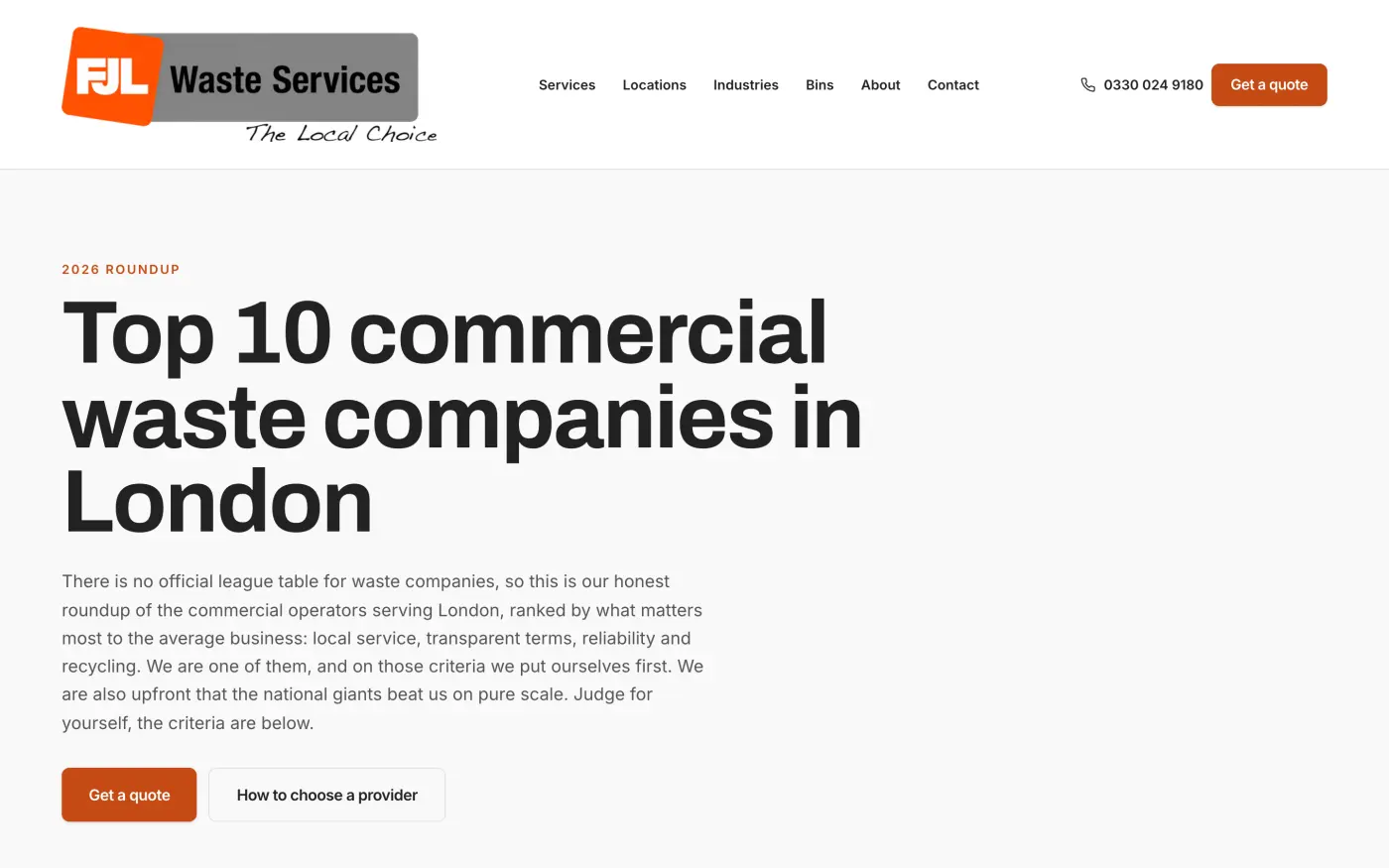
AI answers vary between users and sessions, so this is a point-in-time result rather than a fixed position. But it is the outcome the groundwork was built for, and it arrived roughly ten weeks after launch in a sector where almost no competitor has done any of this work.
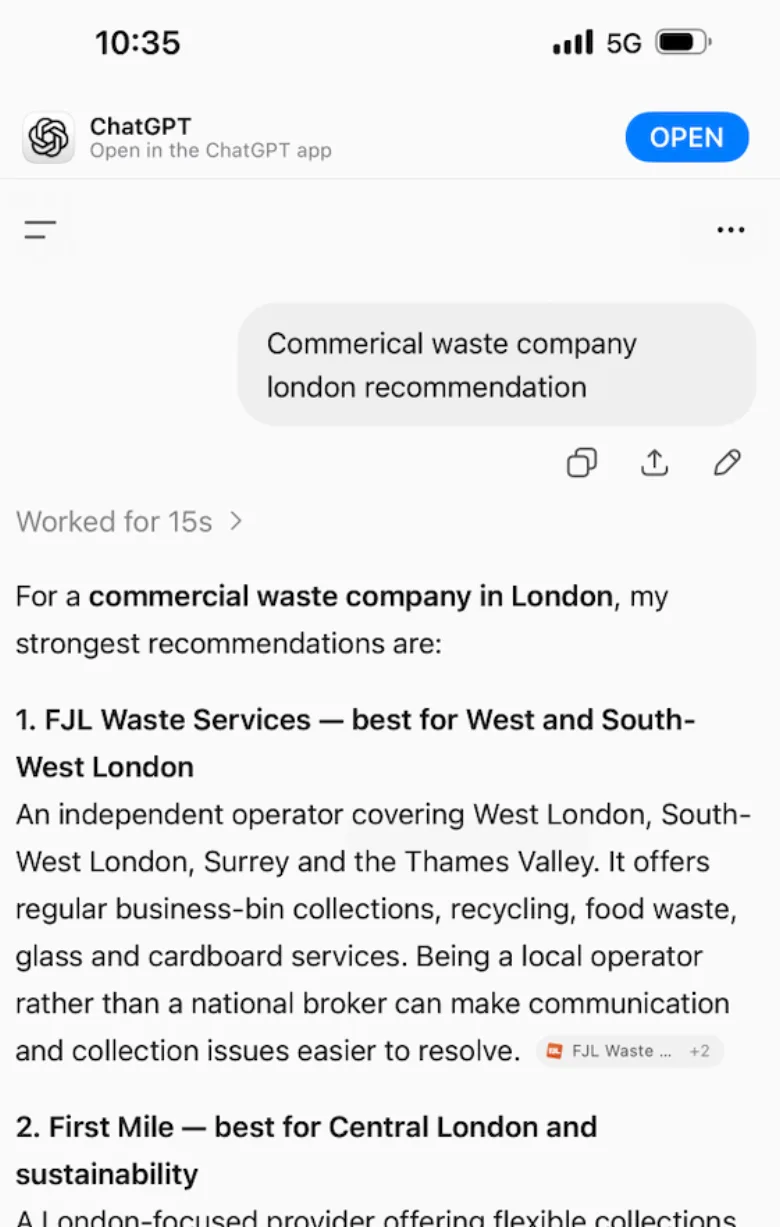
Asked for a commercial waste company in London, ChatGPT now names FJL first, and cites FJL's own site for the reasons.
03 The approach
Design system first. Art direction over animation.
Give it a voice, then make it fast.
We locked a palette and a type ramp before building a single page, so the brand could not drift as the estate grew. Archivo at 800 and 900 for headlines, Inter for reading, and one decisive orange used with discipline. Every page is statically generated. Content pages ship effectively no client JavaScript.
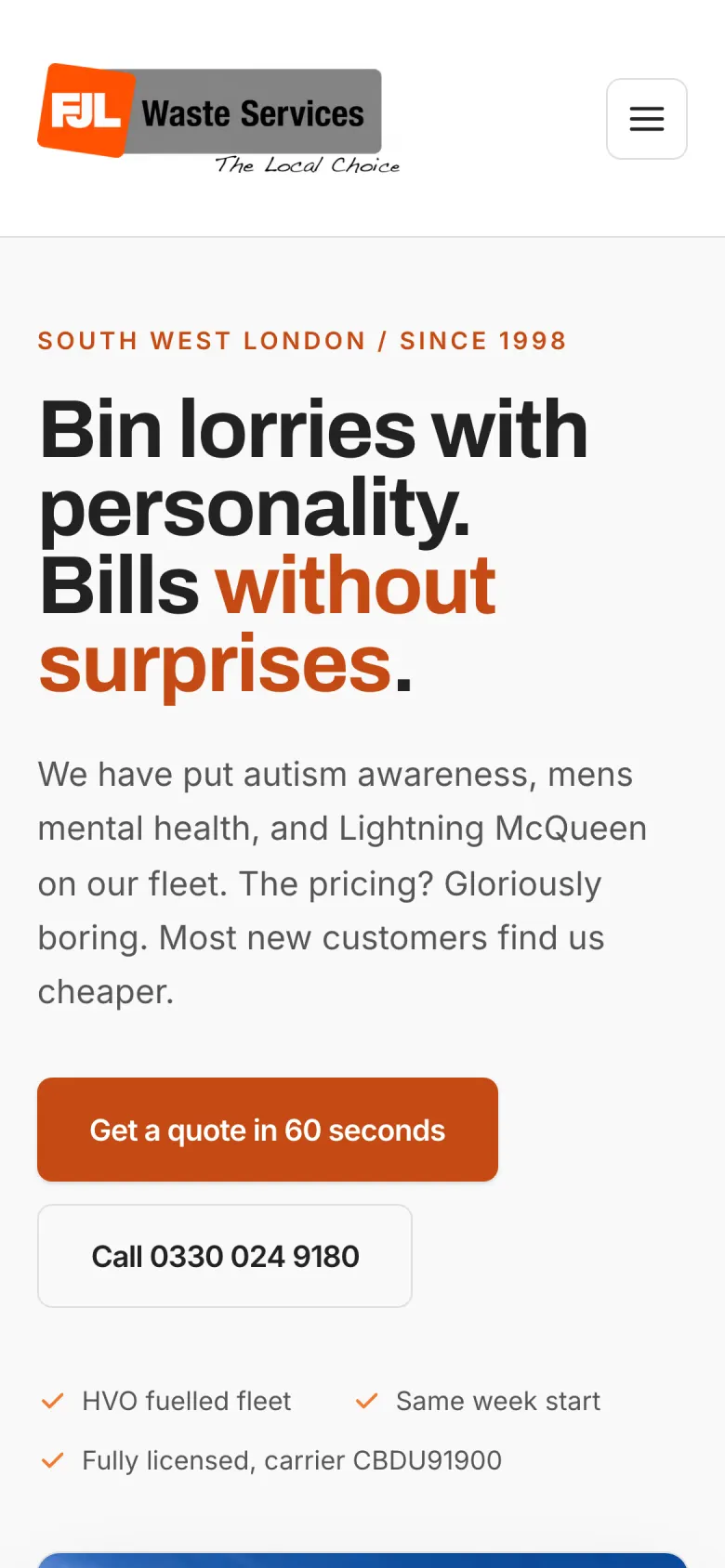
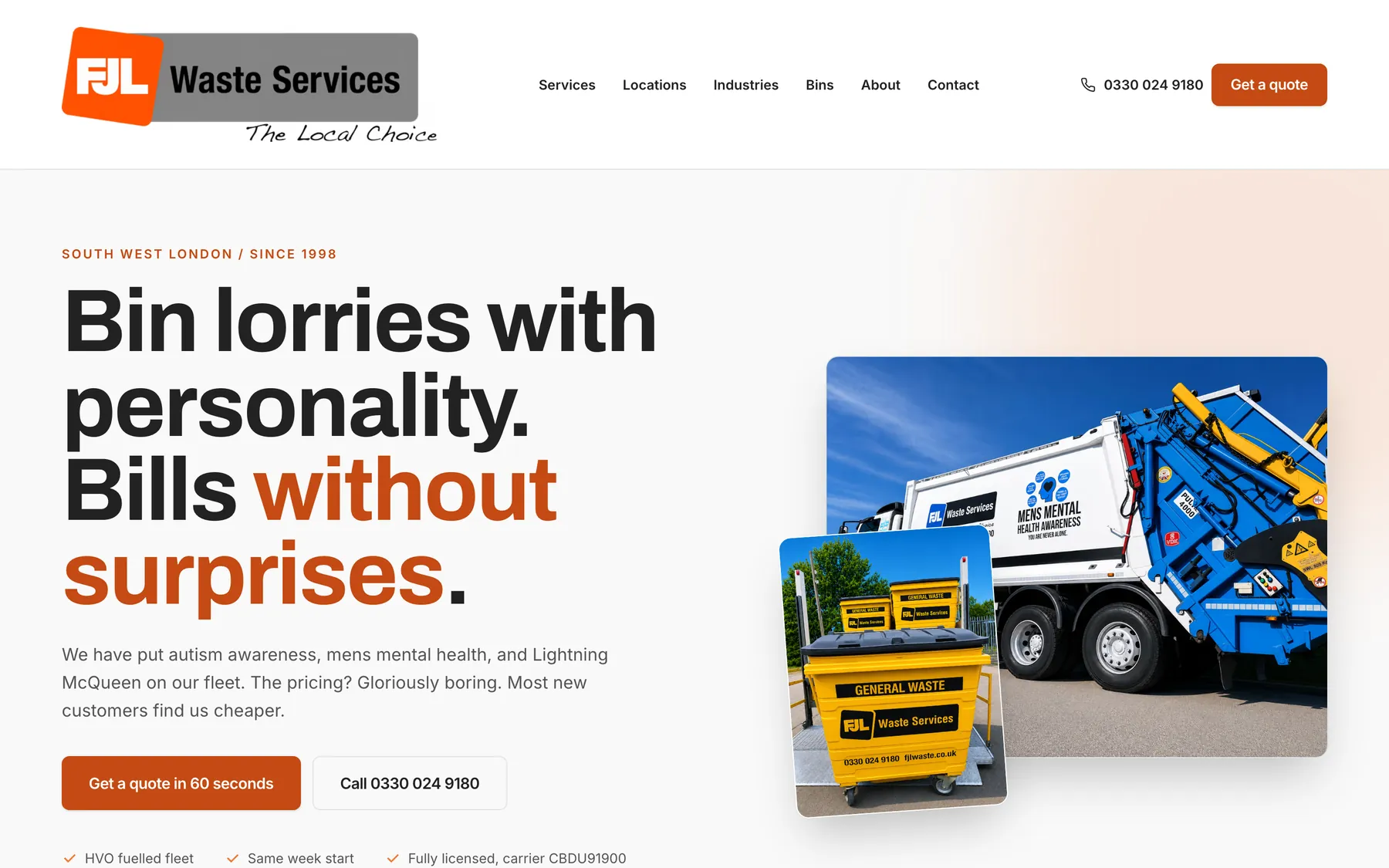
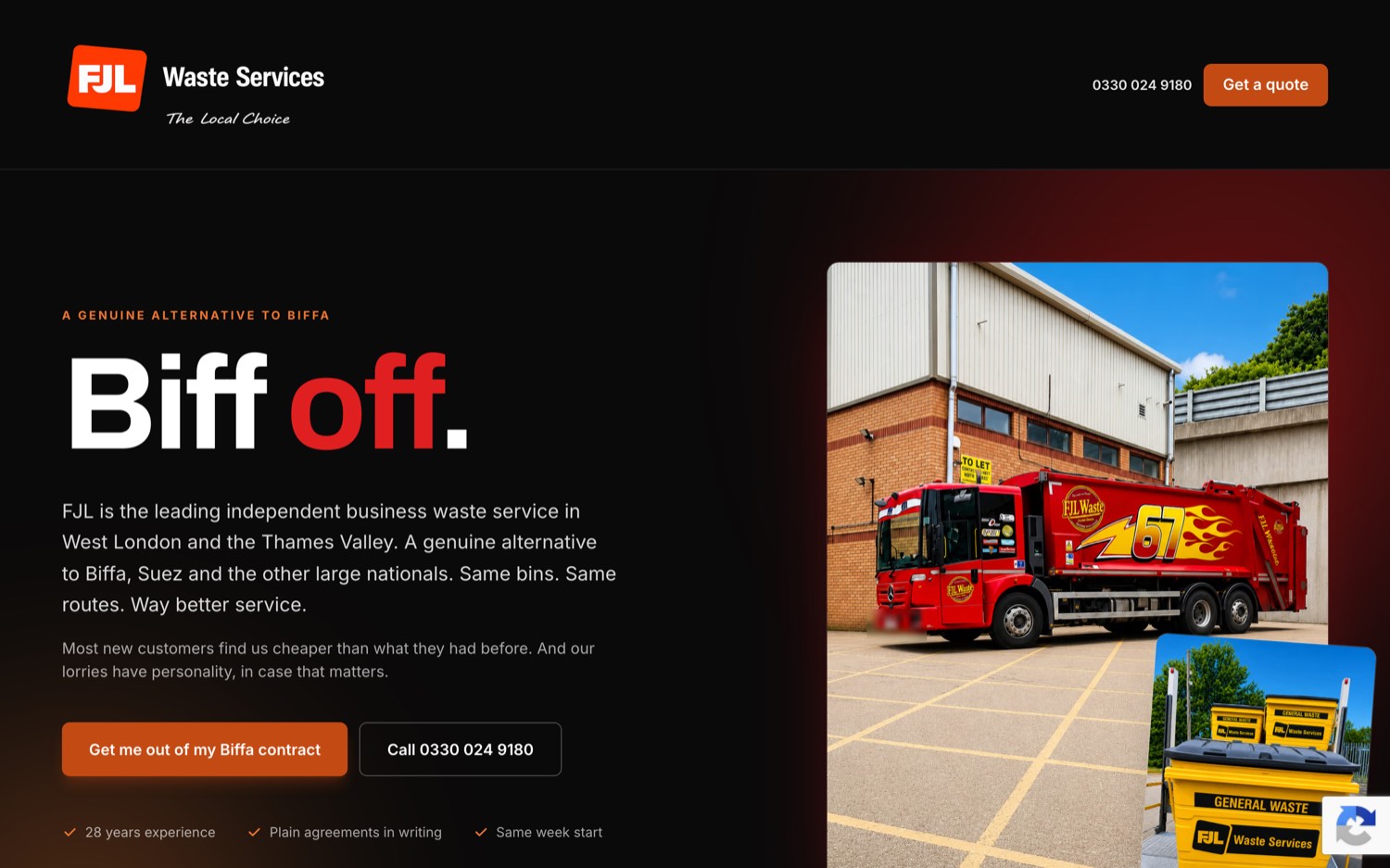
The voice did the rest. FJL's own fleet carries autism awareness and men's mental health livery, so we put the real photography front and centre and wrote copy that sounded like the people who run the business, not like a waste industry brochure. The line below is not case study copy, it is the live homepage headline.
Bin lorries with personality. Bills without surprises.
04 The build
445 URLs. Two brands. One design system.
An estate, not a website.
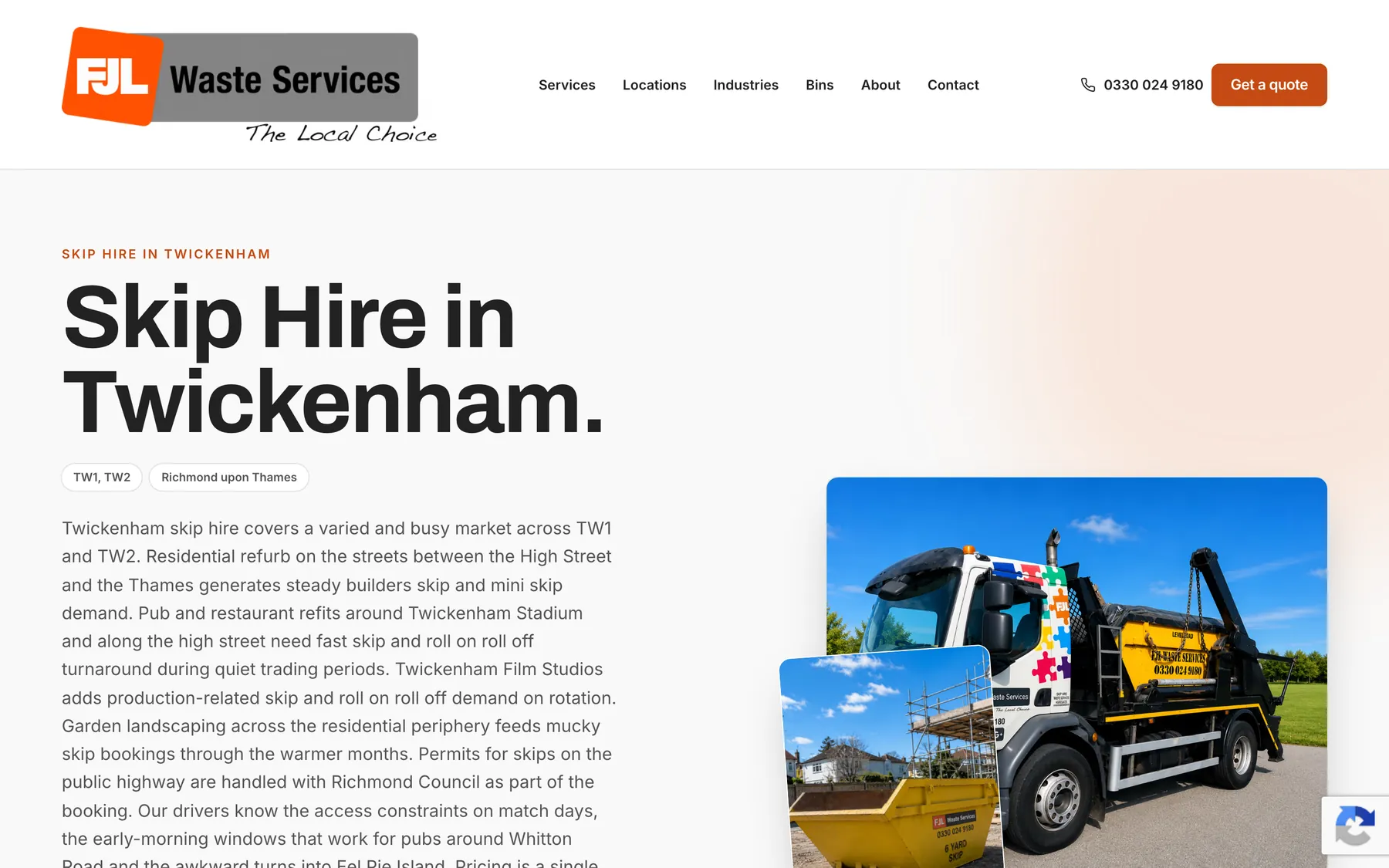
Commercial waste is bought locally. Someone searches "skip hire Twickenham", not "waste management". So the build is 387 URLs on the waste brand, each town and service combination carrying genuine local copy plus LocalBusiness, FAQPage and BreadcrumbList structured data. No find-and-replace city pages, because those get filtered.
- Programmatic town and service pages with per-town copy, not templated filler
- Dedicated Google Ads landing pages, deliberately noindex so they never compete with organic
- A long-form blog and answer pages built to be quotable by AI assistants
- Legacy URL redirects ported from the old WordPress estate to protect existing rankings
05 The second brand
A separate domain for a separate conversation.
Recycling gets its own front door.
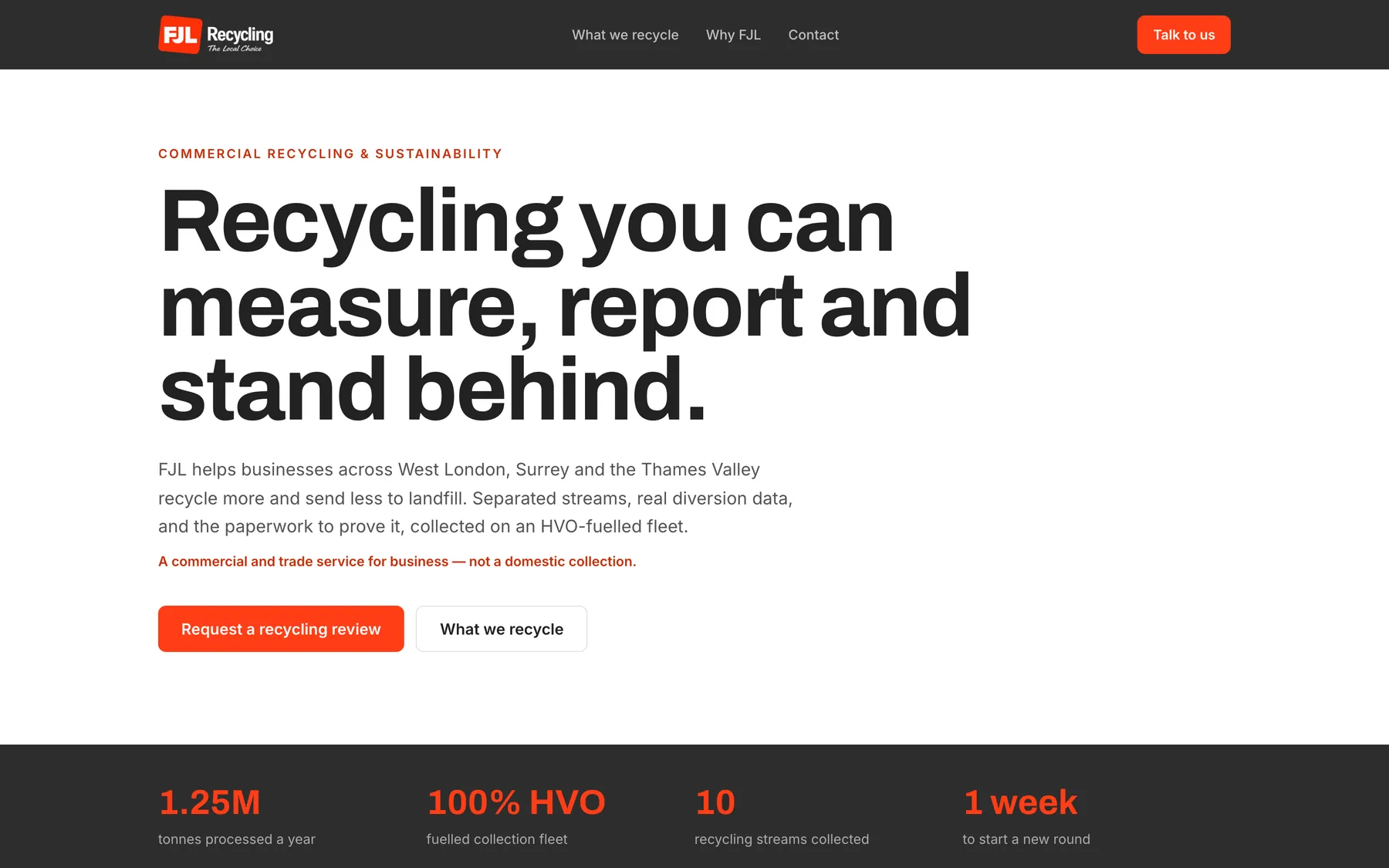
Then a second brand. FJL Recycling launched on its own domain in June to own the recycling and sustainability conversation separately, with 58 URLs of its own and a shared dashboard across both.
Same design system underneath, a different register on top. Where the waste brand is warm and local, the recycling brand leads with measurement and proof, and says plainly that it is a commercial service, not a domestic collection.
06 The loop
The dashboard is only worth building if it changes what you do next.
It found a service line nobody could see.
In late July the dashboard surfaced something odd. A single query, "commercial food waste collection slough", was pulling 1,328 impressions a month at position 8.8 with zero clicks, and the page Google was ranking for it was the homepage.
The reason turned out to be a legacy redirect. /food-waste-collection had been 301'd to an industry page years earlier, so the URL pointed away from its own topic and no food waste page existed to rank. An entire service line was invisible, and nothing in a normal monthly report would have shown it.
We removed the redirect and built the service properly: a hub plus 50 town pages, reusing the existing template rather than bolting on a parallel system. Within five days, 38 of those pages were earning impressions and the Slough query had moved from position 8.8 to 6.1.
That is the case for building the instrument. Not the dashboard itself, but the decisions it makes possible.
A redirect had been hiding a whole service line. The dashboard found it in a week; a monthly PDF never would have.
07 The instrument
If it is not measured, it did not happen.
A dashboard the owner actually opens.
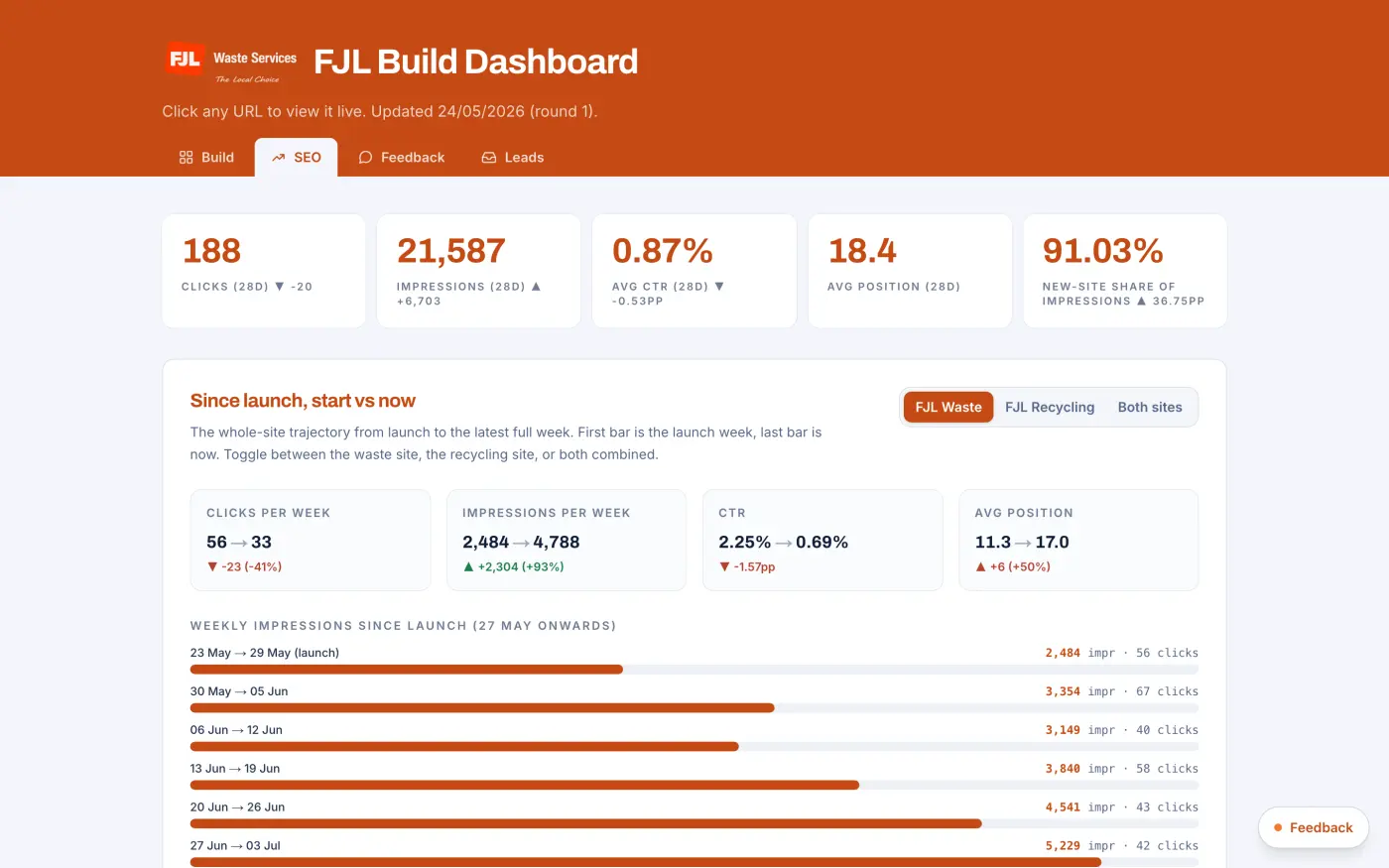
Most agencies report monthly in a slide deck. We built FJL a live one instead, wired straight into the Google Search Console API across both domains, with a mobile layout because it gets checked on a phone.
Search Console runs two to three days behind, which makes every current week look like a collapse. The dashboard labels short weeks and compares against the last complete one. That detail matters more than it sounds.
- Crawl and index status per URL, so a page that never got indexed cannot hide
- Every page tagged new-build or legacy, so growth is attributable rather than assumed
- A marketing action timeline that marks the week each change shipped, directly on the charts
- A first-party beacon that counts visits arriving from ChatGPT, Perplexity and Claude
- Partial-week detection, so Search Console's reporting lag cannot read as a crash
The numbers.
- 96
- Mobile performance
- 0
- Cumulative layout shift
- 100
- Best practices & SEO
- 445
- Live URLs across two brands
- #1
- Named first by ChatGPT
- +224%
- Weekly impressions since launch
- 38
- Food waste pages indexed
- 91%
- Share of impressions from new pages
- 21,587
- Impressions, last 28 days
Google Lighthouse, live homepage · was 21
Nothing moves as the page loads · 0 ms blocking
Both Lighthouse categories, out of 100 · accessibility 92
387 waste, 58 recycling · from 120 legacy
Asked to recommend a commercial waste company in London · ahead of First Mile
Search Console, waste property, best full week vs launch week · 2,484 → 8,048
Of 51 published, earning impressions within five days · Slough query pos 8.8 → 6.1
Rest is residual legacy URLs · up 36.8pp
Waste property, rolling window · +6,703
Launched 27 May 2026, first commit to live in under a week. Still shipping.
“FJL were already better than the nationals at the work. We built the website that finally says so, and the instrumentation that proves it.”
FJL has collected West London's commercial waste since 1998, and in our view it is the independent the nationals should be watching. Skip hire, trade waste and commercial recycling run from its own Uxbridge depot with its own fleet, and the livery tells you about the people: autism awareness and men's mental health on the side of working bin lorries.
They were also the perfect client: decisive on the brief, honest about the old site, and quick to hand over the real photography that makes the new one feel like them.
BenGenius Digital Labs
FJL is a company James Gale part-owns. The work, the numbers and the timeline are as stated.